Huawei pushes HarmonyOS deeper into AI
Huawei is recasting HarmonyOS as a more deeply artificial intelligence-driven operating system, announcing at its HDC 2026 developer conference that HarmonyOS 7 will bring a major upgrade to Xiaoyi, the company’s digital assistant, through what it calls a new “smart brain.”
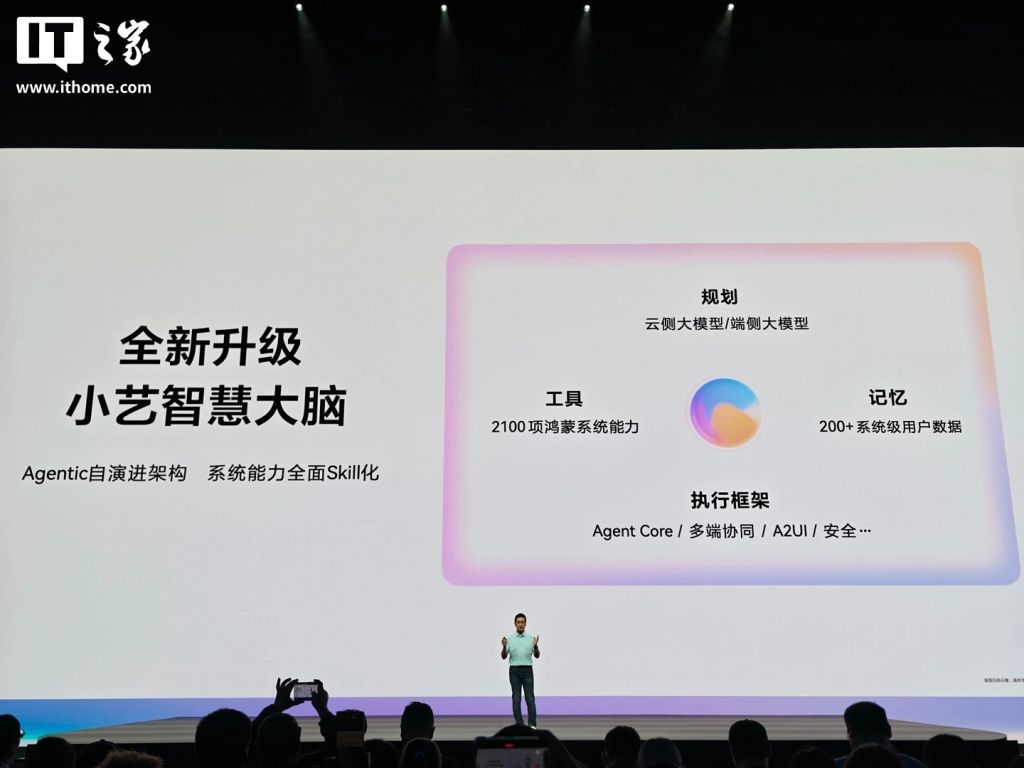
The update, reported by Chinese technology outlet IT Home, centers on an “agentic” architecture designed to let Xiaoyi plan, remember, coordinate and execute tasks across Huawei devices and services. Huawei executive He Gang said the system’s capabilities are being reorganized into “skills,” a structure intended to make the operating system more responsive to complex user requests.
The change reflects a broader shift in consumer technology, as device makers move beyond voice commands and simple automation toward assistants that can carry out multistep tasks. In HarmonyOS 7, Huawei says Xiaoyi will be able to combine cloud-based and on-device large models for planning, draw on more than 2,100 HarmonyOS system capabilities as tools, and use more than 200 categories of system-level user data as memory.
Huawei described the execution framework as including Agent Core, multi-device collaboration, A2UI and safety mechanisms. The company did not fully detail how user data will be stored or protected, but the inclusion of security in the framework signals that privacy and control remain central issues as AI assistants gain broader access to personal information and device functions.
Skills aim to link apps, devices and services
Huawei offered examples of how the new skills-based approach could work. A fitness plan could move from web search to Huawei Health, the calendar and a coaching function. A document-packaging task could begin on a phone, continue through Xiaoyi on a PC, use Xiaoyi search and smart documents, and end with a cross-device notification. A ride-hailing task could connect the calendar, Amap and an alarm.
The examples point to Huawei’s attempt to make HarmonyOS less dependent on individual app silos and more focused on coordinated workflows. Rather than asking users to open several apps and move information manually, Xiaoyi would act as an intermediary that understands the task and selects the necessary tools.
Huawei also said HarmonyOS 7 will support more advanced Xiaoyi functions, including the creation of personal skills and “Vibe Coding,” a term associated with AI-assisted software creation through natural-language prompts. Those additions suggest Huawei wants both ordinary users and developers to extend the assistant’s capabilities.
The announcement comes as HarmonyOS continues to serve as a strategic platform for Huawei, which has worked to build a software ecosystem less reliant on foreign operating systems and services. By emphasizing AI agents, cross-device coordination and user-created skills, Huawei is positioning HarmonyOS 7 as more than a mobile operating system upgrade.
The practical test will be whether Xiaoyi can perform these linked tasks reliably in everyday use. AI assistants often impress in controlled demonstrations but struggle with context, permissions and errors across real apps. Huawei’s challenge is to turn the skills model into a dependable layer of computing that users trust enough to let the system act on their behalf.