Beijing AI conference looks to the future
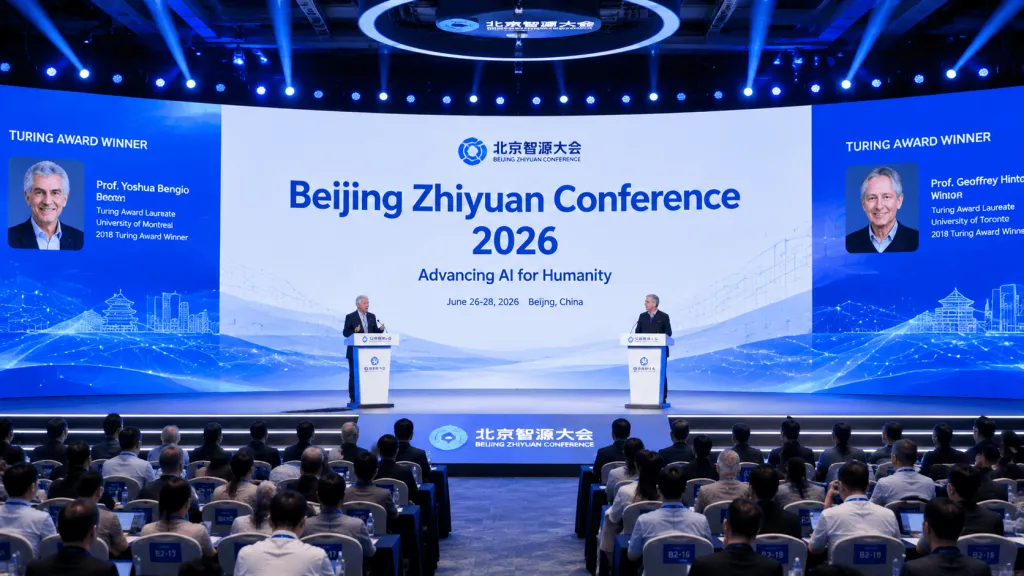
BEIJING — Beijing’s Zhiyuan AI conference closed Saturday with a message that artificial intelligence is moving rapidly beyond text prompts and screen-based tools toward systems designed to act in the physical world.
The two-day gathering, formally the eighth Beijing Zhiyuan Conference, brought together researchers, company founders and technology executives at a moment when China’s artificial intelligence sector is trying to show it can compete globally while building practical applications at home.
Organizers said the conference drew more than 10,000 in-person participants, including two Turing Award winners, eight members of Chinese academies, dozens of young scientists and more than 40 AI company chief executives and founders. Representatives from institutions and companies including Meta, Nvidia, Harvard and MIT appeared alongside major Chinese players such as Alibaba, Tencent, Xiaomi, Shengshu Technology, ModelBest, Tsinghua University, Peking University and Renmin University.
The scale of the event underscored Beijing’s ambition to remain a central venue for global debate over the next phase of AI development. Since its launch, the conference has hosted 14 Turing Award winners and more than 1,000 leading experts, with participation reaching more than 30 countries and regions, according to organizers.
This year’s discussions focused on agents, world models, embodied intelligence, AI safety and the question of how software systems can move from pattern recognition to action. Speakers framed the transition as a shift from artificial intelligence confined to digital environments toward systems that can reason about, predict and interact with real-world settings.
Industry and research seek practical path
The conference also showed how closely China’s AI research agenda is now tied to industry. Chinese technology companies used the event to present work in large models, intelligent agents, video generation, robotics and AI infrastructure, while academic panels examined questions of safety, education, neuroscience and scientific discovery.
One theme running through the meeting was the idea of “world models,” AI systems that try to understand how environments change over time and what may happen next. Researchers and executives described those systems as important for robotics, autonomous decision-making and scientific research, where AI must do more than generate plausible language.
Another focus was embodied intelligence, including humanoid robots and systems that pair perception, planning and movement. That area has become a priority for Chinese companies and local governments seeking to turn AI research into manufacturing, logistics and service applications.
The gathering took place as governments and companies worldwide are debating how to manage AI’s risks while accelerating deployment. Chinese officials and researchers have emphasized safety, open ecosystems and industrial adoption as Beijing pushes to expand domestic computing capacity and reduce reliance on foreign technology.
For international participants, the conference offered a view into China’s fast-growing AI ecosystem. For Chinese companies, it served as a platform to show that innovation is not limited to large language models, but includes chips, software frameworks, robotics and sector-specific applications.
The closing message was optimistic but cautious: AI is entering more complex systems, and its future will depend on whether researchers can make those systems reliable, efficient and safe. In Beijing, the debate was less about whether AI will leave the screen than about how quickly it can do so — and who will set the terms.