
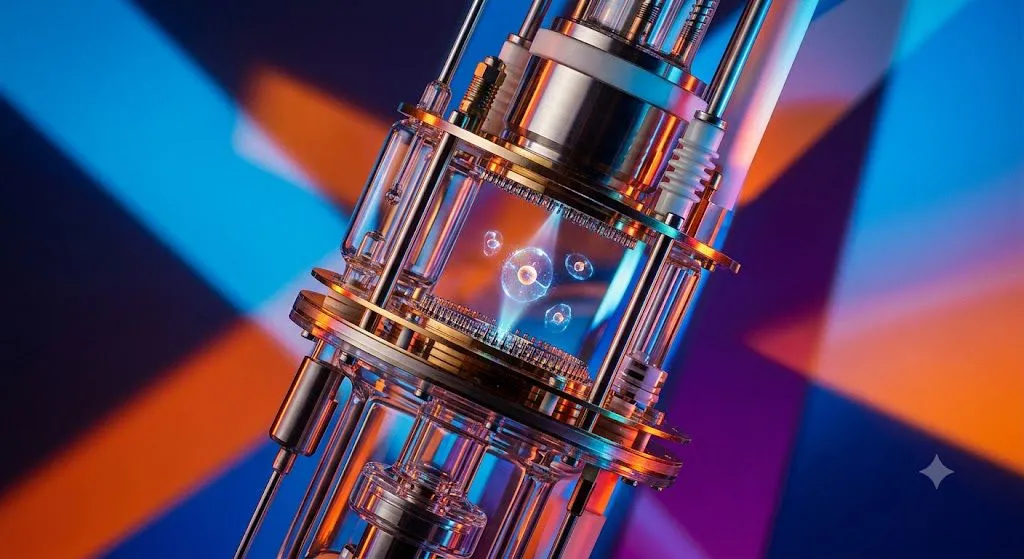
A Peking University (PKU) PhD team has engineered China's sole commercial nano-Kelvin quantum computer, securing substantial funding from Hillhouse Capital for its technological advancement.
This groundbreaking achievement establishes a significant milestone in China’s burgeoning quantum computing sector, demonstrating practical application of ultra-low temperature quantum systems. The device utilizes neutral atom technology operating at near absolute zero temperatures to achieve unprecedented computational stability and precision.
The development represents a critical leap from theoretical physics into deployable commercial hardware, directly addressing the stringent requirements for scalable quantum computation. Researchers successfully managed the complex cryogenic engineering necessary to maintain the nano-Kelvin environment required for qubit coherence in neutral atom arrays.
The funding injection from Hillhouse Capital signals strong private-sector confidence in this specific technological trajectory, validating the intensive research efforts undertaken by the PKU team. This capital infusion is pivotal, allowing the startup associated with the research to transition from advanced prototyping toward broader commercialization and scaling of the quantum processor.
Technical Architecture and Strategic Significance
The core innovation resides in the application of neutral atoms trapped within a highly controlled vacuum chamber maintained at temperatures approaching absolute zero. Operating at the nano-Kelvin level minimizes thermal decoherence, a primary inhibitor to scalable quantum operation. This precise environmental control allows the qubits—individual neutral atoms—to maintain their quantum states for longer durations, drastically improving computational fidelity.
Unlike superconducting qubit approaches that dominate much of the current global research landscape, this neutral atom platform offers inherent advantages in terms of connectivity and scalability potential. The PKU team’s design leverages optical tweezers to arrange and manipulate these atoms with extreme accuracy, forming a robust quantum register capable of handling complex algorithmic operations.
The commercial viability demonstrated by this initial unit is noteworthy because it moves beyond laboratory demonstrations intended solely for academic publication. It signifies the creation of an integrated system—hardware, control electronics, and cryogenic infrastructure—ready for integration into specialized computational environments.
This national achievement places China at the forefront of a highly competitive global race in quantum information science. By developing proprietary hardware capable of operating at such extreme thermal parameters, the team has secured intellectual property advantage in a critical enabling technology for next-generation computation.
Future Trajectory and Market Implications
The partnership with Hillhouse Capital provides more than just financial backing; it offers strategic industry insight necessary to navigate the path from sophisticated laboratory proof-of-concept to market readiness. The immediate focus following this funding round will center on increasing qubit count while preserving the operational stability achieved at the nano-Kelvin level.
The implications for various high-performance computing sectors are profound. Quantum computers built upon stable, controllable neutral atom arrays hold potential applications in complex molecular simulation, materials science discovery, and optimization problems currently intractable for even the most powerful classical supercomputers.
Experts suggest that this development could accelerate China's self-sufficiency in critical quantum infrastructure components. Reliance on foreign entities for core quantum hardware presents a strategic vulnerability; domestic production of such highly specialized equipment mitigates this risk significantly.
The journey toward a universally fault-tolerant quantum computer remains long, but the establishment of a functional, commercially funded nano-Kelvin system represents a tangible and verifiable step along that trajectory. Further developments from the PKU team will closely track advancements in neutral atom trapping fidelity and operational uptime as they move into larger computational regimes.