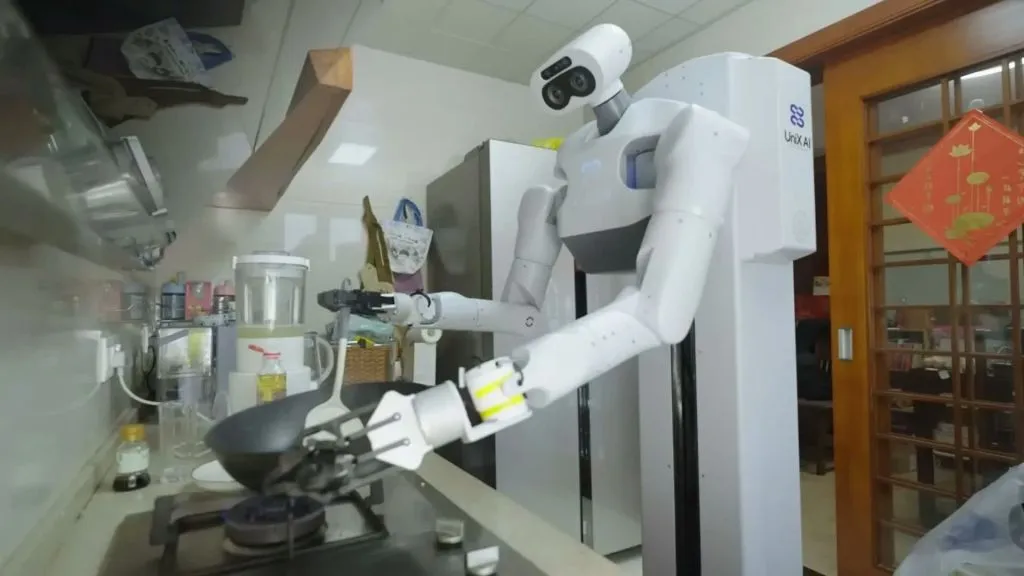
Embodied AI robots are entering Chinese homes for household chores, available for just 74 Yuan for a three-hour service, marking a significant shift toward domestic automation.
Affordable Robotics Disrupting Domestic Labor
The deployment of these automated assistants signals the rapid maturation of embodied artificial intelligence within the consumer market in China. These robots are designed to handle routine household tasks, effectively challenging traditional models of domestic labor through accessible pricing structures.
According to reports, users can engage the robotic services for a minimal fee, specifically 74 Yuan covering three hours of operational time. This low entry cost suggests a strategic move by developers to accelerate user adoption and prove the viability of AI in private residential settings.
The technology represents a convergence point between advanced robotics engineering and massive consumer demand for efficiency gains within increasingly dense urban living environments. These machines are not merely proof-of-concept models; they are being integrated into daily life with commercial availability.
This trend aligns with China's broader national push toward smart manufacturing and digital transformation across all sectors, extending from industrial production lines into the private domicile. The accessibility of this technology suggests that household automation is moving beyond high-end luxury goods into the realm of mainstream consumer electronics.
Technological Capabilities and Market Trajectory
The specific tasks these embodied AI units are capable of performing define their immediate market value. While precise functional breakdowns vary by model, the core capability involves navigating complex domestic environments to execute predetermined chore sequences autonomously.
The underlying artificial intelligence allows these robots to perceive their surroundings—identifying objects, mapping rooms, and executing fine motor skills required for cleaning or organizing. This level of environmental awareness is critical; it separates sophisticated robotic assistance from simple automated appliance functionality.
Market analysts view this rapid commercialization as a strong indicator of the maturity curve in Chinese AI hardware development. The focus is shifting from achieving technical milestones to achieving economic scalability and practical user integration.
For consumers, the implication is a potential reduction in the time burden associated with domestic maintenance, allowing for reallocation of personal time toward professional or leisure activities. This addresses a known demographic pressure point within modern Chinese society.
The success of the 74 Yuan offering will serve as a crucial benchmark for future iterations of household AI robots globally. If these models can maintain operational reliability and safety at this price point, they set a new standard for accessible domestic automation technology, making advanced robotics less of a niche novelty and more of an expected utility.
Further examination of the deployment patterns will reveal whether the initial focus remains on basic cleaning functions or if the AI architecture supports increasingly complex, multi-step household management routines in the near future. The original report details these early market entries.