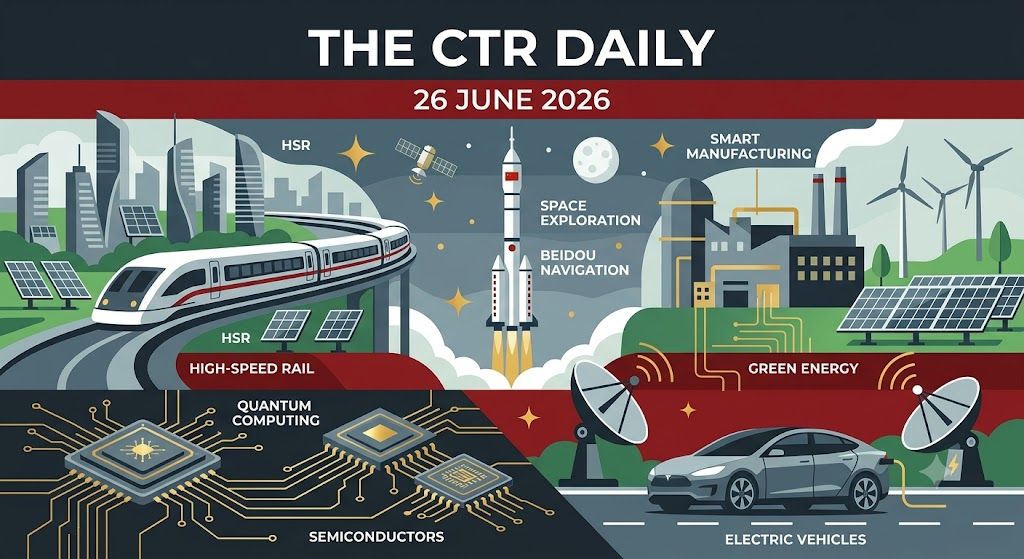
Today’s CTR: China tech’s mood over the past 24 hours is assertive, litigiously defensive and increasingly physical. Beijing is selling its innovation boom as a global bargain rather than a strategic threat, while its companies are trying to turn that argument into market share in artificial intelligence [AI], chips, robotics and electric vehicles [EVs]. The subtext is less subtle: export controls have not stopped China from building, but they have made every benchmark, lawsuit and factory robot feel geopolitical. The day’s stories show a system moving from apps to infrastructure—and from infrastructure to machines with arms, wheels and occasionally very good lawyers.
China’s LineShine takes the supercomputer crown, with an asterisk for the AI age
China’s LineShine system has taken the No. 1 spot in the latest Top500 supercomputer ranking, beating America’s El Capitan by a reported 22%. The Shenzhen-based machine is notable not only for its speed, but also for its reliance on domestically developed central processing units [CPUs] rather than the graphics processing units [GPUs] that dominate many modern AI systems.
The impact is symbolic and strategic. For Beijing, LineShine is a proof point that U.S. export controls have not frozen China’s high-performance computing ambitions. For Washington, the lesson is more uncomfortable: denying access to foreign chips may slow some paths, but it also makes local alternatives politically unavoidable.
The reach is not quite as sweeping as the headline suggests. Traditional supercomputers are still vital for scientific simulation, defense and industrial research, but the AI race increasingly depends on specialized clusters built around accelerators and software ecosystems. LineShine wins the benchmark; Nvidia still owns much of the developer mindshare.
China has won a trophy that matters, even if the game is changing under everyone’s feet. Source
Li Qiang recasts China’s tech rise as “opportunity,” not shock
Chinese Premier Li Qiang used the World Economic Forum’s Annual Meeting of the New Champions in Dalian to argue that China’s technological advances should be seen as “China Opportunity 2.0,” not “China Shock 2.0.” He pushed back against Western complaints that subsidies are the main driver behind China’s gains in EVs, AI, robotics, chips and batteries.
The impact is diplomatic but also commercial. China is trying to keep doors open for its technology exporters at a time when governments in the U.S. and Europe are tightening trade defenses. Li’s pitch is that Chinese scale makes advanced technology cheaper for the world; critics hear the same sentence and worry about industrial displacement.
The reach is broad because it touches every contested frontier of China tech. EVs, solar panels, AI systems and robotics are no longer separate policy debates; they are now bundled into one argument about whether Chinese efficiency is a public good or a market shock.
Beijing’s message to the world is simple: do not call it overcapacity when the products are useful and inexpensive. Source
Alibaba sues the Pentagon over its military-linked designation
Alibaba has filed a federal lawsuit against the U.S. Department of Defense after being added to a Pentagon list of Chinese companies alleged to have military links. The company argues that the designation has “no basis in fact or law” and says it was effectively blindsided by the decision.
The impact is larger than one company’s reputation. Alibaba is not just an e-commerce platform; it is a cloud, AI and enterprise software company whose Qwen models are increasingly central to China’s AI stack. A military-linked label may not be a full sanctions regime by itself, but it can chill partnerships, complicate lobbying and raise compliance anxiety among customers.
The reach also extends across China’s blue-chip technology universe. The same updated list reportedly added names across EVs, batteries, displays, robotics and solar, making the Pentagon roster a kind of geopolitical weather map for investors.
Alibaba is asking a U.S. court to remove a label that markets may already have priced in. Source
Anthropic’s Alibaba allegation turns AI distillation into a policy fight
Anthropic has accused Alibaba of using Claude through thousands of fake accounts to train smaller AI models, according to the Financial Times. Anthropic, which does not operate Claude in China, reportedly urged U.S. lawmakers to tighten access to advanced AI chips.
The impact is that “model distillation” is shifting from a technical practice into a national-security accusation. Distillation can be a legitimate way to compress model behavior into smaller systems, but when it crosses platform rules and borders, it becomes part of the broader fight over who paid for the frontier and who gets to copy its edge.
The reach is especially important for Chinese open-source AI. Companies such as Alibaba, DeepSeek and others are competing partly by offering capable, cheaper models that travel well across enterprise use cases. If U.S. firms persuade policymakers that Chinese model progress depends on illicit copying, future restrictions may target software access as much as silicon.
The AI arms race is discovering that the cloud has borders after all. Source
Hua Hong Grace shows China’s chip story is not only about cutting-edge nodes
Hua Hong Grace Semiconductor is seeing gains from a 40-nanometer ultra-low-power specialty process that has entered stable mass production, while its Wuxi 12-inch line continues to ramp. The development sits far from the bleeding edge of AI accelerators, but it matters for the practical electronics that keep cars, industrial equipment and connected devices running.
The impact is a reminder that semiconductor self-sufficiency is built in layers. China still faces steep barriers at advanced nodes, but mature and specialty processes can deliver strategic resilience in power management, microcontrollers, displays, sensors and automotive electronics. Not every chip needs to be glamorous; some just need to be available.
The reach is potentially wide because specialty foundry capacity feeds the industrial base that China is trying to automate and electrify. In that sense, Hua Hong Grace is part of the less photogenic side of the tech contest: the slow accumulation of dependable process capability.
In chips, the 40-nanometer factory may matter more to China’s real economy than the 4-nanometer press release. Source
China’s robotics push becomes a demographic strategy, not just a tech story
China is leaning harder into robotics and embodied AI as it tries to offset a shrinking and aging workforce. Manufacturers are automating more labor-intensive processes, while companies and policymakers are pushing humanoid robots into factories, logistics and services.
The impact is economic first and social second, though the second may prove harder. Robots can support productivity in a country with fewer young workers, but automation also collides with youth unemployment and the insecurity of hundreds of millions of gig workers. China’s old bargain—growth in exchange for stability—gets trickier when the new growth engine has fewer human seats.
The reach is global because China already has scale advantages in manufacturing, supply chains and deployment. If robotics follows the pattern of solar panels or EVs, foreign competitors may find themselves debating labor policy at home while Chinese producers are already cutting unit costs abroad.
China is not merely building robots; it is trying to automate its way around demography. Source
BYD wants humanoid robots in showrooms, because cars are now software theaters
BYD executive vice president Stella Li said the company wants to put humanoid robots in every car showroom and is developing robots in-house for service and home uses. She also pointed to future “dark factories,” or highly automated production facilities, over the next three to five years.
The impact is that China’s EV leaders are no longer just carmakers. BYD, Xpeng, Li Auto and others are moving toward AI-enabled hardware ecosystems where manufacturing, sales, software and robotics reinforce one another. A showroom robot may sound like marketing theater, but it also trains consumers to see the car brand as a broader technology platform.
The reach is competitive. BYD’s robotics ambition puts it closer to Tesla’s Optimus narrative, but with China’s manufacturing density and domestic robotics suppliers behind it. The showroom may be the soft launch; the factory floor is the prize.
In China’s EV market, the next differentiator may be the robot explaining the car before another robot helps build it. Source