
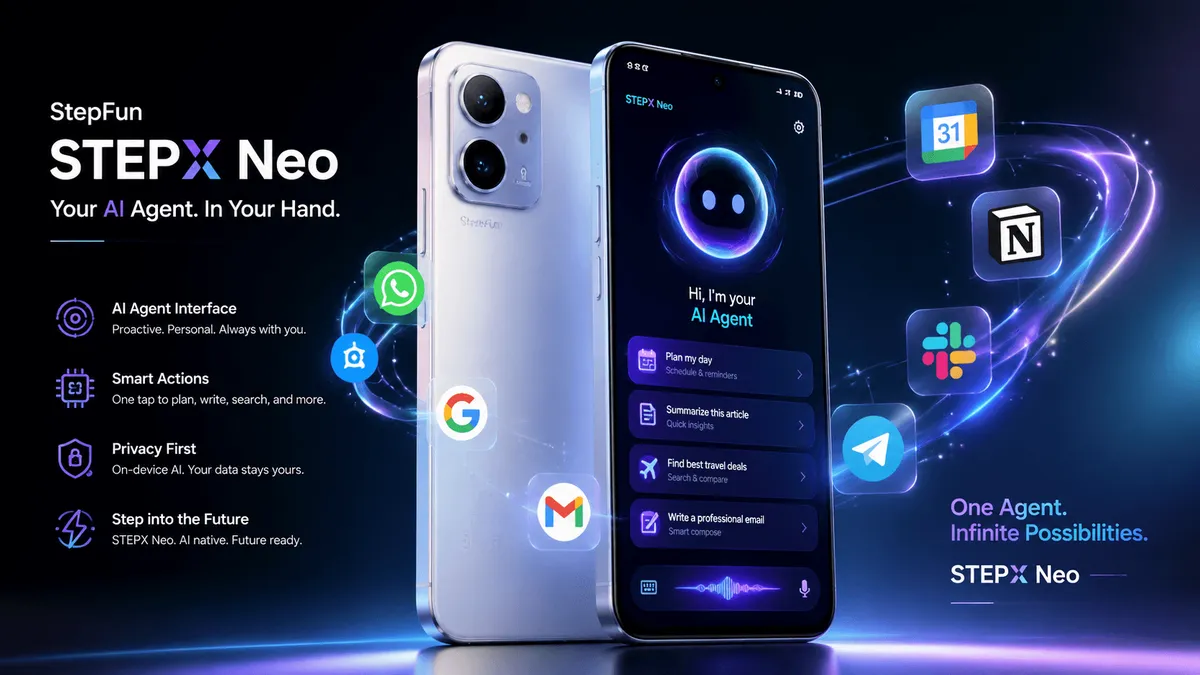
StepFun unveiled the STEPX Neo, an AI agent phone capable of autonomously integrating major Chinese platforms including Alipay, Meituan, Didi, and Baidu.
Cross-Platform Autonomy Redefines Mobile Interaction
The release signals a significant shift toward deeply integrated, autonomous mobile operating systems in the highly competitive Chinese tech landscape. The STEPX Neo is engineered not merely as a smart device but as an intelligent agent designed to execute complex tasks across disparate third-party applications.
Central to this capability is its sophisticated integration framework, which allows the phone's AI to interact with services like Alipay for financial transactions, Meituan for food ordering, Didi for ride-hailing, and Baidu for search and mapping without requiring constant manual user intervention. This level of cross-app autonomy moves beyond simple widgets or linked accounts; the device acts as a proactive digital representative.
Analysts suggest this capability addresses a primary friction point in current mobile usage: context switching. Instead of opening four separate apps to manage a complex outing—such as ordering food, hailing a ride, and paying—the STEPX Neo is designed to orchestrate these processes using natural language commands or inferred user intent.
The underlying technology powering the agent appears to leverage advanced large language models (LLMs) specifically tuned for real-time operational execution within closed-loop enterprise ecosystems. The ability to maintain state and context across multiple, distinct API boundaries represents a considerable engineering hurdle that StepFun claims to have overcome.
This strategic move positions the STEPX Neo not as a standalone consumer gadget, but potentially as an interface layer between the user and the vast digital infrastructure of China’s super-apps. The success of this integration hinges on the robustness and security of these cross-platform calls.
Implications for Future Mobile Computing
The introduction of such an agentic device has profound implications for how consumers will interact with their technology moving forward, potentially accelerating the trend toward ambient computing. Traditional smartphone interfaces are inherently reactive; they wait for a tap or swipe. The STEPX Neo introduces a proactive element.
StepFun's focus on integrating dominant domestic services—Alipay and Meituan being foundational to daily Chinese life—demonstrates a clear market targeting strategy aimed squarely at the high-density usage patterns within Mainland China. These partnerships are not peripheral; they form the operational backbone of the phone’s intelligence.
Furthermore, the device's integration with Baidu suggests capabilities extending into knowledge retrieval and localized service discovery. For instance, a user could command the phone to "find me the best highly-rated Sichuan restaurant near my current location that accepts Alipay," prompting the AI to navigate Meituan and confirm payment options via Alipay simultaneously.
Industry observers are closely monitoring how this architecture scales. While initial deployments prove concept viability, widespread adoption requires flawless execution across diverse user behaviors and unpredictable environmental variables. The technical challenge shifts from merely connecting APIs to ensuring reliable, instantaneous decision-making under real-world pressure.
The STEPX Neo represents a concentrated effort to move the smartphone paradigm from being a collection of applications housed on one screen to becoming a singular, intelligent operational entity capable of navigating the digital ecosystem autonomously. Further analysis will focus on the latency and error handling capabilities demonstrated in live usage scenarios.