Honor unveiled the world's first robot phone capable of dancing at the World Artificial Intelligence Conference (WAIC), showcasing advanced mechanical engineering and proactive artificial intelligence.
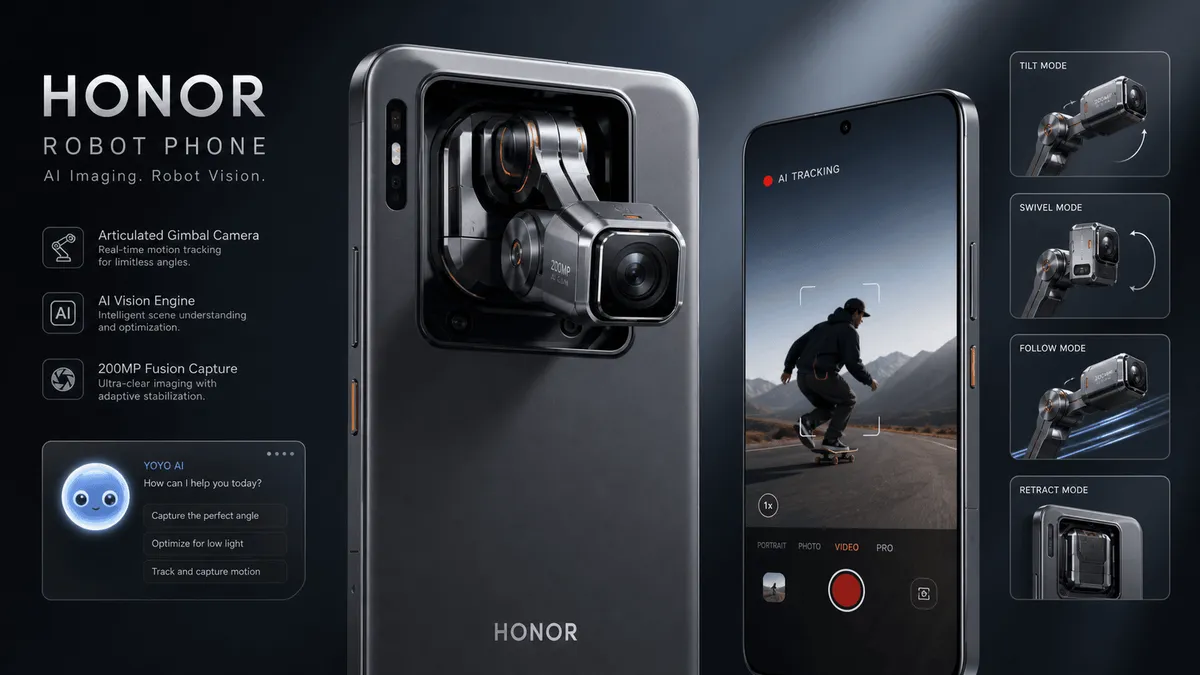
The debut device, which integrates complex mobility with smartphone functionality, represents a significant leap in the intersection of hardware design and autonomous software capabilities. During the showcase, the Honor Robot Phone demonstrated coordinated movements using a 4-Degrees-of-Freedom (4DoF) mechanical gimbal system, allowing it to execute intricate dance routines.
This technological achievement moves beyond simple remote control, indicating a level of onboard intelligence that permits the robot to react and perform autonomously. The core innovation lies in coupling this physical dexterity with proactive AI algorithms designed not merely to follow pre-programmed paths but to interpret and respond dynamically within its environment.
Technological Specifications and Capabilities
The 4DoF mechanical gimbal is central to the robot's performance, providing the necessary degrees of freedom for fluid and complex motion. This specific configuration allows the device to maintain balance while executing dynamic movements typical of dance choreography, a feat previously reserved for more specialized humanoid platforms.
What distinguishes this offering from existing robotic showcases is the implementation of proactive AI. Traditional robotics often relies on reactive programming—the robot senses an input and executes a corresponding action. The Honor Robot Phone’s system appears designed to anticipate movement requirements or environmental shifts, allowing it to initiate complex sequences without constant external command.
Sources indicate that this level of integrated intelligence allows the phone to interpret its operational parameters in real-time. This transition from mere automation to proactive autonomy is a critical marker in advanced robotics development, suggesting an evolving relationship between hardware capability and cognitive software layers.
The presentation at WAIC served as a public demonstration of Honor's strategic push into the high-end consumer AI market segment. By embedding sophisticated mobility within a device recognizable as a "phone," the company is challenging traditional boundaries separating mobile computing from embodied robotics.
Implications for Future Consumer Electronics
The unveiling signals a potential pivot point where personal technology moves beyond being purely handheld interfaces to becoming active, mobile entities capable of physical interaction with the world. If successfully scaled and refined, this concept could redefine expectations for next-generation smartphones.
The integration demonstrated suggests that future consumer electronics may need not only powerful processing units but also sophisticated low-latency actuation systems. The success of the 4DoF gimbal in a compact form factor is particularly noteworthy for industrial miniaturization trends.
Industry analysts view this development as symptomatic of broader industry momentum toward 'embodied AI.' Companies are increasingly recognizing that true artificial intelligence requires a physical manifestation—a body—through which it can actively sample and influence reality. The Honor Robot Phone serves as a tangible proof-of-concept for this trend.
Further details regarding the commercial availability and specific performance metrics of the robot phone have not been released, but its debut confirms that sophisticated robotics is rapidly migrating from laboratory demonstrations into high-profile technology showcases like WAIC.