Global technology is splitting into two realities. At the government level, Washington and Beijing are tightening controls, widening export restrictions and signaling that advanced chips, AI systems and sensitive manufacturing know-how are strategic assets. Yet at the company level, the flow of capital, engineering talent and commercial necessity has not stopped. It has simply become more selective, more layered and more dependent on legal workarounds, joint ventures and carefully fenced partnerships. The result is a technology market that looks increasingly decoupled in policy terms, but still stubbornly interdependent in practice. U.S. export controls on advanced computing semiconductors have continued to tighten, while Chinese authorities have also been weighing limits on overseas access to their most advanced AI models.
Business, Not Bluster, Is Still Driving the Deal
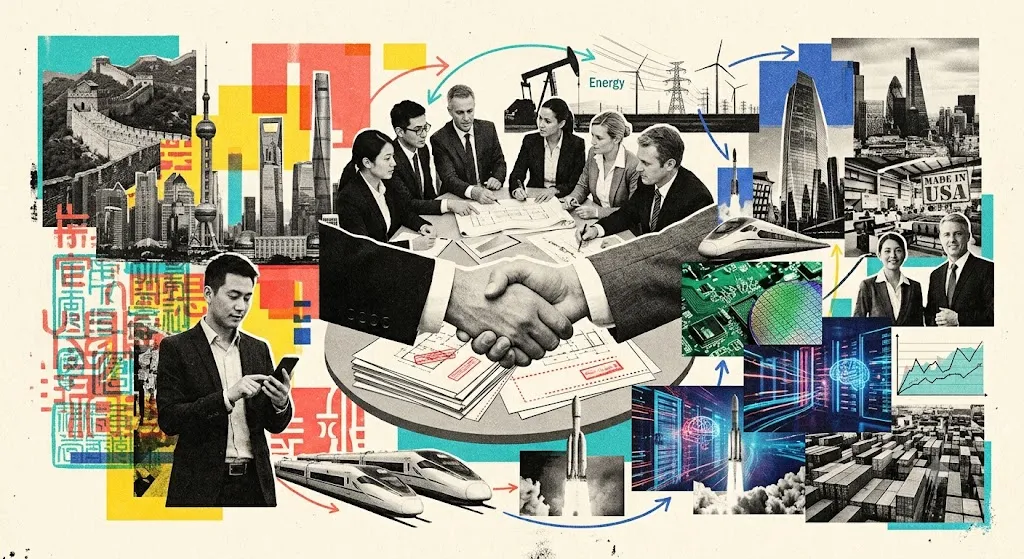
For all the rhetoric about strategic rivalry, the private sector still runs on a simpler calculus: where is the market, where is the technology and where is the money? That is why Chinese and Western firms are still finding ways to work together in autos, energy, semiconductors and AI infrastructure, even as governments push the other way. In many cases, the motivation is not ideological at all. Western companies want access to China’s scale and manufacturing ecosystem. Chinese companies want the latest tools, specialized components or foreign distribution. The incentive structure has changed, but it has not disappeared.
Some of the most visible examples are in autos, where global carmakers and Chinese partners continue to deepen ties rather than unwind them. Reuters reported in May that Stellantis and Leapmotor planned joint car production in Europe, a sign that Chinese electric-vehicle know-how is increasingly being exported rather than merely imported. Around the same time, Stellantis and Dongfeng outlined plans for a European joint venture to sell Dongfeng’s Voyah-branded vehicles. These are not token arrangements. They are evidence that, even amid tariffs and security screening, automakers still see value in combining Chinese product speed with Western branding, financing and market access.
Energy is following the same pattern. Reuters reported that Octopus Energy, Britain’s largest electricity supplier by market share, formed a joint venture with China’s PCG Power to trade renewable energy in China. Deals like this point to a broader reality: even as governments debate energy security and industrial policy, companies still need partners who can move quickly, manage local regulations and scale infrastructure. In practice, the market often rewards cooperation before politics can catch up.
The New Geometry of Control
The hardest edge of the technology relationship is in semiconductors and AI. Here, governments are not merely nudging behavior; they are trying to redraw the map of what can and cannot cross borders. The U.S. Commerce Department’s Bureau of Industry and Security has repeatedly strengthened controls on advanced computing semiconductors and related licensing rules, including tighter scrutiny of chips used for AI workloads. Those rules are meant to limit China’s access to the hardware that powers frontier models and advanced data centers.
Yet the corporate response has been adaptation rather than retreat. Reuters reported that Tencent secured access to Nvidia’s high-end AI chips in Japan through a local intermediary, Datasection, a structure that illustrates how companies are re-routing around direct restrictions rather than abandoning demand. Reuters also reported that Chinese AI firms have formed alliances to build a more domestic ecosystem as they cope with U.S. export restrictions on Nvidia chipsets. The message is clear: where direct access is blocked, firms look for third-country channels, local substitutes or pooled development models to keep projects moving.
This is where the new geometry of control becomes visible. Governments want to fence off strategically sensitive technologies, but corporations are redesigning their operating models to fit inside the fence. The result is not a clean break between Chinese and Western technology systems. It is a patchwork of licensed transfers, overseas subsidiaries, joint development and ring-fenced supply chains. That structure may be less efficient than the old era of open globalization, but it is still workable enough for executives who need revenue, data, customers and scale. In that sense, the market is not defeating policy. It is simply moving around it.
A Fractured World, but Not a Sealed One
The broader business signal is that foreign firms have not written off China, even after years of policy tightening and geopolitical strain. Reuters reported in January that German companies’ investments in China hit a four-year high in 2025, underscoring how business leaders still see a commercial case for staying engaged. More recently, Chinese state-media reporting said nearly 4,800 foreign enterprises increased investment in China in the first half of 2026, with high-tech sectors drawing particular interest. Those figures do not mean the relationship is healthy or uncomplicated; they mean it remains economically valuable enough that firms are still willing to take the political risk.
That is the central paradox of the current era. Governments are trying to separate technological ecosystems, while firms are trying to preserve them. The first instinct of states is to classify, restrict and screen. The first instinct of companies is to partner, adapt and comply just enough to keep operating. That tension will not disappear soon. If anything, it is likely to intensify as AI, chips, electrification and advanced manufacturing become even more central to national power. For now, though, the headline is not full decoupling. It is selective entanglement: a world in which politics pulls apart and business quietly stitches together what it still can.