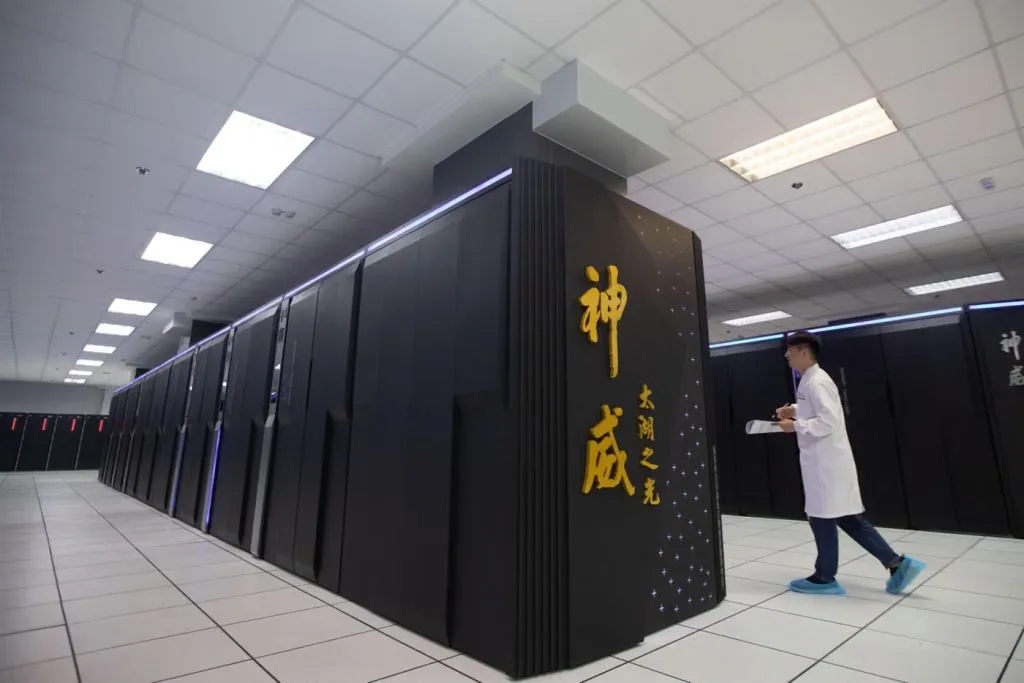
China’s LineShine takes the top spot
A new Chinese supercomputer has vaulted to the top of the global ranking of the world’s fastest machines, marking China’s return to No. 1 and widening the small but growing club of publicly listed exascale systems.
LineShine, installed at the National Supercomputer Center in Shenzhen, debuted at No. 1 on the June 2026 TOP500 list announced at the ISC high-performance computing conference in Hamburg. The system recorded 2.198 exaflops on the High Performance Linpack benchmark, the standard measure used by the ranking, displacing the U.S. Department of Energy’s El Capitan system at Lawrence Livermore National Laboratory.
The result makes LineShine the first TOP500 system to exceed two exaflops of sustained double-precision performance using only central processing units, according to TOP500. Its theoretical peak is 2.736 exaflops, meaning the machine reached about 80% of its maximum rated performance in the benchmark run.
The system was built by the Shenzhen Cloud Computing Center and uses a custom Chinese processor on the LingKun platform, with 13.79 million cores across 304-core LX2 processors running at 1.55 GHz. It is linked by the proprietary LingQi interconnect and runs Kylin OS. TOP500 said the machine draws about 42.2 megawatts of power, yielding 52.07 gigaflops per watt.
LineShine’s arrival is also politically significant. It is the first Chinese system to lead the TOP500 since 2017, when Sunway TaihuLight was overtaken by U.S. machines. Its design underscores China’s push to rely more heavily on domestic components as U.S. export controls limit access to advanced chips and semiconductor tools.
A broader exascale race
The new ranking places five systems above the exascale threshold on Linpack for the first time, spreading that capability across Asia, North America and Europe. El Capitan fell to second with 1.809 exaflops, followed by Frontier at Oak Ridge National Laboratory with 1.353 exaflops and Aurora at Argonne National Laboratory with 1.012 exaflops. Germany’s JUPITER Booster, operated by the Jülich Supercomputing Centre, reached exactly 1.000 exaflop and ranked fifth.
LineShine also led the HPCG benchmark, which is designed to better reflect memory movement and communication patterns in scientific applications, with 22.00 petaflops. But it ranked fourth on HPL-MxP, a mixed-precision test often associated with artificial intelligence workloads, behind El Capitan, Aurora and Frontier. TOP500 said the smaller gain on mixed precision was consistent with LineShine’s CPU-only architecture and lack of dedicated low-precision accelerators.
That distinction matters because the supercomputing race is no longer only about traditional simulation. National laboratories, universities and companies are increasingly using leadership-class machines for climate modeling, nuclear security, drug discovery, materials science and AI development. GPU-heavy systems often excel at mixed-precision AI tasks, while CPU-only systems can still provide large-scale capability for scientific codes that depend on double-precision arithmetic and complex data movement.
The rest of the top 10 reflected a more varied field. Eni’s HPC7 entered at No. 6, Microsoft’s Azure-based Eagle fell to No. 7, followed by Eni’s HPC6, Japan’s Fugaku and Switzerland’s Alps. TOP500 said the list showed there is no single path to leadership-class computing, with custom Chinese architectures, AMD-based U.S. systems, Intel designs, Nvidia Grace Hopper systems, cloud-based machines and Japan’s Fujitsu-built Fugaku all represented.
Energy efficiency remains a growing concern as machines consume power on the scale of small cities. The Green500 list was again led by KAIROS at CALMIP and the University of Toulouse-CNRS in France, at 73.28 gigaflops per watt. LineShine’s top ranking, however, signals that raw performance leadership has entered a new phase — one defined by exascale machines across multiple continents and by a renewed contest over who controls the technologies inside them.