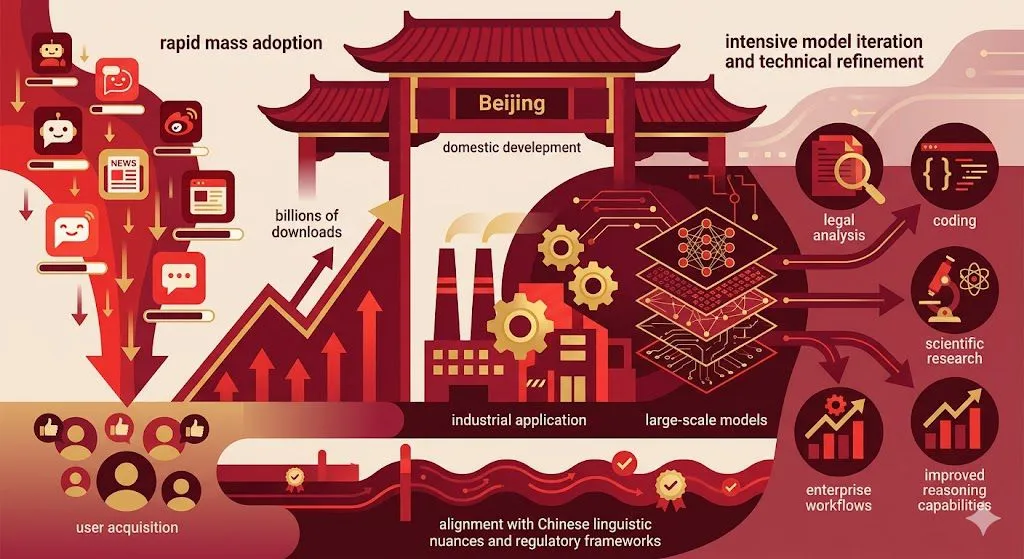
BEIJING: Following a period of rapid mass adoption characterized by billions of downloads, China’s artificial intelligence sector has entered a new phase defined by intensive model iteration and technical refinement. Domestic developers are shifting their focus from mere user acquisition to the deployment of increasingly sophisticated large-scale models designed to improve reasoning capabilities and industrial application.
The current wave of development follows an initial surge in consumer interest that saw various domestic LLMs (Large Language Models) achieve massive download figures across mobile platforms. Industry analysts note that this transition marks a maturation of the local ecosystem, as companies move beyond general-purpose chatbots toward specialized iterations that address specific sectoral needs, such as coding, legal analysis, and scientific research.
Source data indicates that these new iterations are prioritizing higher parameter efficiency and improved alignment with Chinese linguistic nuances and regulatory frameworks. As the market becomes increasingly crowded, the competition has moved from the quantity of available models to the quality of their outputs and their ability to integrate into complex enterprise workflows.
The rapid cycle of updates suggests a high-pressure environment for domestic tech giants and emerging AI startups alike. Developers are facing mounting pressure to demonstrate tangible return on investment as the cost of training and maintaining these massive computational structures remains high. This shift toward iterative improvement is expected to drive further consolidation within the industry, favoring firms that can successfully bridge the gap between theoretical model performance and practical, scalable utility in a production environment.